
What a Samurai Knew About Learning Japanese
Notes on Mushin, Chun, and letting a language enter the body, not just the mind.

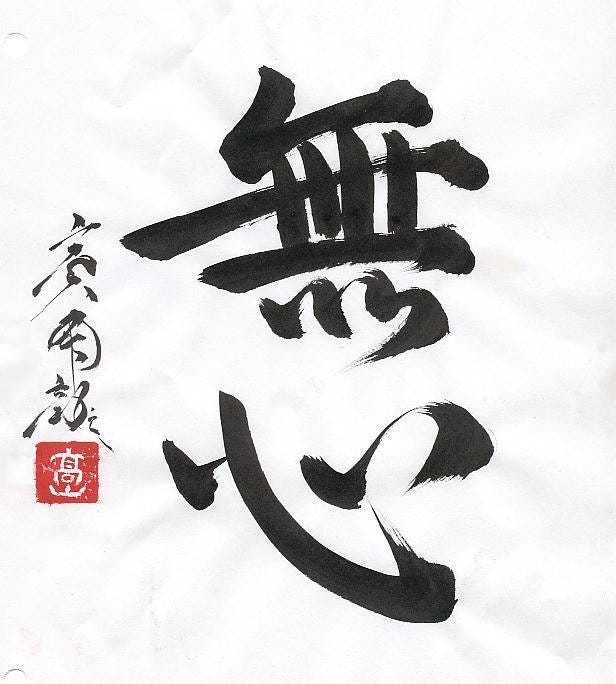

Sometimes I have the feeling that the universe is trying to hint at something. This morning, I read an essay by Emiko Takahashi, a Japanese-American writer and tea ceremony practitioner, about a Japanese word I hadn’t met before: Mushin (無心). I recognized it immediately as a possible guide for learning the language. According to the author, the concept is often misunderstood in the West, where it gets flattened into the idea of an “empty mind” — passive or absent. In reality, the two kanji that compose it — mu (無, “without”, “empty”) and shin (心, “heart”, “mind”, “spirit”) — point to a state of full presence, in which action is no longer blocked by excessive calculation, judgment, or attachment to outcome.
This attitude, born in the context of Zen and refined in the martial arts, runs through many practices of Japanese culture: the tea ceremony, calligraphy, ikebana, the contemplation of a garden. Trying to go deeper, I found it again in another tradition: The Book of Five Rings by Miyamoto Musashi, who lived at the hinge between the era of feudal conflict and the consolidation of the Tokugawa order — a swordsman and strategist who crossed an epochal threshold at the margins of the social order. His figure was later mythologized, but he remains, above all, someone who turned his experience of the margin into a mental cartography.
The most interesting part, for anyone studying Japanese, is the Book of Earth — the section that describes the foundation, the existential and philosophical ground on which every later learning rests. Without solid bases — the hiragana and katakana syllabaries, the structure of the verb, the first kanji — the architecture of the language risks collapsing. But in Japanese, “earth” is not a chapter that closes: it is a ground that keeps rearranging itself. Even when you think you have built something stable, the next level reopens complexity, with thousands of kanji and ever more subtle registers of politeness. Error is not failure, but evidence that you are actually moving inside a living language — one that never lets itself be fully dominated.
To describe this sense of disorientation, the third hexagram of the I Ching can help: Chun, “Difficulty at the Beginning”.
Below is Zhen, Thunder — the force pushing upward; above is Kan, Water, here read as the Abyss, an obstacle, a zone of uncertainty. The structure of the hexagram captures, almost perfectly, what happens in the study of Japanese: a deep energy trying to emerge, compressed within an area of emotional and cognitive difficulty. The point is not to force the passage, but to move through the difficulty with order and patience, accepting that the seedling grows precisely because it meets resistance.
To this connects zanshin — the “remaining mind”: the continuity of presence that stays awake before, during, and after the gesture is performed. In the martial arts, it is the moment when, after the strike, you do not drop your guard, but remain alert to the possibility of new contact. For the student, it means bringing a concrete presence to the desk: observing the stroke of a kanji, a particle, a syntactic nuance, without getting distracted or rigid. But zanshin is also what you do after the study session: you don’t immediately close the book to check your phone — you let the language go on resonating in the silence for a few minutes. This attention, however, must be paired with wu wei, action without forcing — a principle the Taoist tradition made central, and which flowed together with Mahayana Buddhism into Chinese Chan and then into Japanese Zen. It does not mean stopping the work, but refusing to turn study into a war against memory. If a grammar rule does not enter today, forcing it will not help; sometimes it is better to let it settle, change topic, return later, giving the brain the biological time it needs.
Only at the end of this path does Mushin reveal its deepest value. It is not about memorizing the language, but about freeing it when the moment to use it arrives: in a real conversation with a native speaker, in a piece of writing where you allow yourself to flirt with imperfection. It is the threshold that switches off the inner judge and interrupts the analysis paralysis that blocks us right as we are about to say a sentence. “Without mind” is not the absence of thought, but a more agile form of presence — one in which even the “you who watches yourself speaking” dissolves into the speaking itself. You speak even when you are not in control of everything, accepting the risk of the void rather than losing the dialogue.
All of this, though, is not just abstract philosophy: it can translate into a small daily practice. Chun — the initial difficulty — is honored through a daily ritual of earth, small but non-negotiable. It means setting aside a fixed slot each day, however short, for the construction of the foundations. For a beginner, this might look like:
15–20 minutes on hiragana and katakana in the first days,
then 15–20 minutes on vocabulary, plus 5–10 new kanji a day, paying attention to stroke order,
a short review of the previous day.
It is not about learning everything at once, but about creating a small habit that does not break for at least four to six weeks, even on days when it shrinks to ten minutes.
This is how Chun stops being only an obstacle and becomes a ritual.
Zanshin arrives when you learn to listen to your own mind while it studies. It is the state of focused concentration in which you decide: “these twenty minutes are for the language only — and in this time I do not look at the phone, I do not read the message, I do not check the notification.” You can study with a timer, in sessions of 20–25 minutes followed by 5 of pause, and during the session you keep asking yourself: am I really listening to the word? Am I repeating the sound? Am I writing the kanji with attention to its strokes, not just copying a symbol? This attitude not only improves the form but also builds a mental habit. Language asks for presence, not just superficial contact.
Wu wei, instead, is the principle that regulates the overall rhythm. It is the decision not to turn learning into a war against memory, but to let the language filter in slowly, even when you don’t catch everything. In practice, this means:
listening to podcasts, anime, or Japanese songs in the background while walking, cleaning the house, doing the shopping — without forcing yourself to understand every word,
not tormenting yourself when a grammar rule does not enter today; you can leave it, do something lighter (vocabulary, listening), and return to it in a few days,
shortening the study session when you are tired, but not canceling it: ten minutes are worth much more than zero.
It is in this patient flow that the language begins to enter the body, not just the head.
Finally, Mushin is the door that opens when you decide to speak — even if the language still feels smudged and trembling. It is switching off the inner narrator who judges every syllable. It is pronouncing a sentence in Japanese, knowing it is imperfect, allowing the silence to stretch longer than expected, slipping in a word of Italian or English when needed. It is an act of trust in your own voice: a language does not become “right” when you are perfect, but when you dare to use it — and you learn from the outcome, not from the theory. You can start with just three to five minutes a day, in front of the mirror, then with a tandem partner, a conversation group, or an online exchange. It is in those moments — when you really speak — that philosophy stops being a beautiful image and becomes a concrete act.
So, after all this, a student of Japanese can do something simple but not easy: each day, dedicate a small piece of earth (Chun) to focused but limited study; cultivate zanshin with short, intense sessions; let wu wei regulate the overall rhythm, without titanic efforts and without paralysis from fear; and allow oneself mushin whenever the level permits — that is, whenever one speaks. This is where philosophy stops being just a beautiful image and becomes a concrete act.
In this way, the sword of Musashi and the seedling of Chun are no longer only metaphors. They become the way you hold the book, the phone, your body, your voice — while Japanese, slowly but with stubborn regularity, begins to sound authentic
Sensei has expressed some enlightening concepts (Mushin, Wu wei & Zanshin) that this student holds dear in his life.
The concept of Wu Wei effortless action is what I strive for in my own personal journey.
Very charming and apt application of philosophy to language learning! As a lover of language and the Chinese tea ceremony I enjoyed reading it, even though I'm not studying Japanese :)